
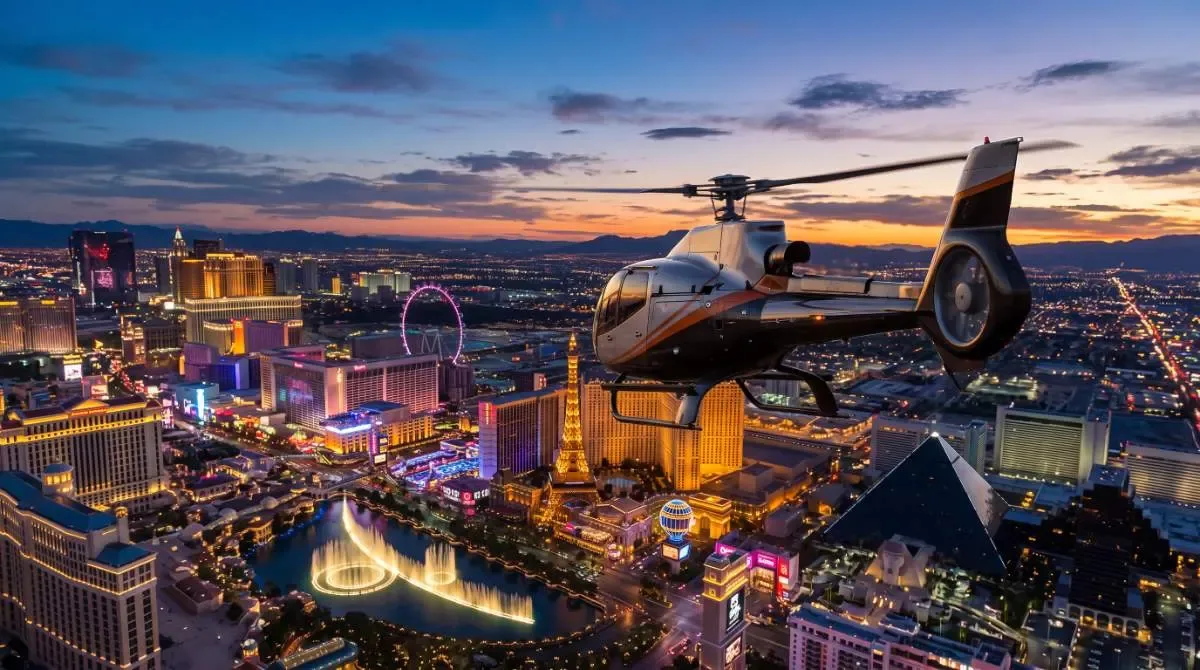
Helicopter tours out of Las Vegas mostly split into two categories: short Strip night flights over the neon skyline, and longer Grand Canyon tours that land on the canyon floor or fly the rim -- several operators offer both. Here are the top four helicopter tour companies:
- Maverick Helicopters — Strip night flights from $139, Grand Canyon landing tours from $599, and combo Strip+nature packages.
- Papillon Grand Canyon Helicopters — Long-running operator with short Strip flights, Golden Eagle air tours, and Grand Celebration landing tours from two terminals.
- 5 Star Helicopter Tours — Grand Canyon West Rim air and landing tours plus Strip night flights from $99, Red Rock Canyon and Valley of Fire options.
- GC Flight — Grand Canyon floor-landing tours, Rim + Strip combos, and Red Rock Canyon landing tours from Boulder City.
A helicopter ride is one of the few Vegas experiences that lives up to the hype. The hard part isn't deciding whether to go — it's sorting through a dozen near-identical tour names, wildly different price tags, and fine print about weight limits and entry fees that nobody mentions until you're standing at the check-in desk.
Every figure below is a starting rate as of mid-2026, and they move around a lot by date, season, and demand. Treat them as a planning range and confirm the current total on the operator's own site.
The two main types of tour
Almost every Las Vegas helicopter tour falls into one of two buckets.
Las Vegas Strip flights put you over the neon for roughly 10–15 minutes. Most run after dark, when the Strip is at its most dramatic, though daytime departures exist. Door to door, budget one to two hours once you factor in check-in and transport.
Grand Canyon West Rim tours are the bigger commitment: about 3.5 to 4.5 hours hotel-to-hotel, with roughly 45 minutes of flying each way. You can go air-only, or pay more to land inside the canyon.
Beyond those two, operators also run Red Rock Canyon and Valley of Fire flights (often with a landing and a champagne toast), Hoover Dam and Lake Mead routes, sunset departures, and combination packages that stitch several together.
Helicopter landings inside the Grand Canyon are only permitted at the West Rim, on Hualapai tribal land. National Park Service rules prohibit below-rim landings at the South and North Rims. If landing inside the canyon is your goal, the West Rim is your only option — and that's exactly where Las Vegas tours go.
The main operators
Maverick Helicopters
Premium · South Strip terminal · EC130 fleet only
Maverick flies Airbus EC130 "ECO-Star" helicopters exclusively — wraparound glass, forward-facing theater-style seating — and departs from its own terminal near the Welcome to Fabulous Las Vegas sign.
- Vegas Views — Strip night flightfrom $124
- Wind Dancer — canyon landing, ~4 hrsfrom $599
- Wind Dancer Sunsetfrom $629
- Red Rock Canyon landing + Strip$239–$279
Maverick's canyon landing site is a private bluff around 3,500 feet below the rim and roughly 300 feet above the Colorado River, with about 30 minutes on the ground, champagne, and light snacks. The hotel shuttle is typically a paid upgrade rather than included.
Papillon Grand Canyon Helicopters
Founded 1965 · Widest selection · Two terminals
The longest-running operator in the region, and one that claims the world's largest fleet of sightseeing aircraft. Papillon offers by far the widest menu of options, often at the most competitive prices.
- Strip Highlights — night flightfrom $124
- Golden Eagle — air-only canyon tourfrom $449
- Grand Celebration — canyon landingfrom $479
- Celebration with Strip — landing + flyoverfrom $729
Two things to check when you book. Departure point: Papillon runs terminals both on Las Vegas Boulevard and in Boulder City, about 30 minutes southeast of the Strip, and several of its most popular canyon tours — including the Golden Eagle — leave from Boulder City. Shuttles are available, but it adds ground time. Aircraft type: Papillon flies a mixed fleet, so if the EC130 EcoStar specifically matters to you, confirm which helicopter is assigned to your tour.
5 Star Helicopter Tours
Boutique · Private heliport near Harry Reid Airport
A smaller operator with a reputation for polished ground service — Mercedes Sprinter or private SUV transfers rather than a shared shuttle bus.
- Strip night flightsfrom $99
- Valley of Fire / Red Rock with landing30 min on ground
- Twilight upgrade on several tours+$69
Good value if you want a boutique feel without paying full premium rates.
GC Flight
25+ years · Las Vegas and Boulder City · Group-friendly
Flexible and well-suited to groups, custom bookings, and combination trips — canyon flights paired with ATV rides, kayaking, or a Colorado River rafting run. Rim and floor landings advertised from around $419.
Sundance Helicopters — no longer flying tours
Tour operations closed August 2020
You'll still find Sundance in old blog posts, guidebooks, and search results. It shut down its tour operation permanently in August 2020 after the pandemic collapse in Vegas tourism, and was acquired in 2023 by Original 6 Capital, which runs it as a utility and charter operator. If a third-party site is still selling you a Sundance tour, that's a red flag about the site.
Which tour should you pick?
If you want to stand inside the canyon
Grand Celebration or Wind Dancer
The most immersive version of the experience. The price gap between operators mostly reflects service level, not what you'll see.
If you have one free evening
A Strip night flight
Twelve minutes in the air, well under $150, and the highest wow-per-dollar option in the city. Ideal for first-timers and couples.
If photographs are the point
Sunset canyon + Strip return
Golden light on the canyon walls outbound, the Strip lighting up beneath you on the way home. These sell out first.
If you want something other than the canyon
Valley of Fire or Red Rock
Shorter, cheaper, genuinely striking. Red Rock is 20 minutes out; Valley of Fire is 55 miles northeast with more varied terrain.
Wanting Hoover Dam and Lake Mead specifically? No need for a dedicated tour — both sit on the outbound route of essentially every Grand Canyon flight.
What does it cost?
| Tour type | Typical starting price |
|---|---|
| Strip night flight | $99–$179 |
| Red Rock / Valley of Fire with landing | $239–$349 |
| Grand Canyon air-only | $419–$529 |
| Grand Canyon with canyon landing | $479–$749 |
| Sunset canyon + Strip return | $629–$749+ |
What's usually included
The flight, pilot narration, and a safety briefing. Landing tours add ground time inside the canyon, a champagne toast, and light snacks. Hotel pickup is included on many packages and a paid upgrade on others — this is the single most common source of price confusion, so check before comparing quotes.
Extras that can catch you out
- Grand Canyon West entry fees. Grand Canyon West is on Hualapai tribal land and is not part of Grand Canyon National Park. National Park passes are not valid there. If your tour includes ground time at the rim, an All-Access Pass is normally bundled into the price; if you're adding rim time yourself, that's a separate cost.
- Skywalk tickets, which are almost never included in a basic canyon tour.
- Fuel surcharges, more common on third-party bookings than direct ones. Major operators generally quote all-in prices on their own sites.
- Extra-seat charges for passengers over the weight threshold.
- Front-seat upgrades, offered by some operators for roughly $50–$60 — though final seating is always determined by weight and balance.
- Gratuities, customary for pilots and ground staff.
How long does it take?
Strip flights: 10–15 minutes in the air; about 1–2 hours total including check-in and transfers.
Grand Canyon tours: roughly 45 minutes of flying each way, plus 20–30 minutes on the ground if your tour lands. Total is typically 3.5–4.5 hours hotel-to-hotel, and longer for combination tours that add a boat ride, Skywalk visit, or extended rim time.
Add 30–45 minutes for check-in, weighing, and the safety briefing. Most operators ask you to arrive 30 minutes before departure, and late arrivals can be denied boarding without a refund.
Where do tours leave from?
South Strip terminals. Maverick's terminal sits near the Welcome sign; Papillon also operates from Las Vegas Boulevard. Easy to reach from most resorts.
Boulder City Airport. About 30 minutes southeast of the Strip. Several Papillon and GC Flight canyon tours depart here. It adds ground transfer time but often comes with a lower fare, and it's closer to the canyon.
Private heliports near Harry Reid Airport. 5 Star and a handful of smaller operators.
Hotel pickup is widely available from Strip and near-Strip properties, either included or as an upgrade. Self-drive with on-site parking works at most terminals too, and can save you a lot of shuttle time.
What will you actually see?
On a Strip flight: the Bellagio fountains, the Sphere, the Luxor beam, the High Roller, Allegiant Stadium, the Strat, Caesars Palace, and downtown's Fremont Street Experience.
On a canyon route: Hoover Dam and the Mike O'Callaghan–Pat Tillman Memorial Bridge, Lake Mead, Fortification Hill (an extinct volcano), Temple Rock, the Grand Wash Cliffs, the West Rim's layered walls, and the Colorado River. Many return routes pass the red rock formations of the Bowl of Fire.
If you land: 20–30 minutes on a private plateau roughly 3,500 feet below the rim. You'll be above the Colorado River rather than at the water's edge — reaching the river itself requires a tour that includes a pontoon boat leg. There's no hiking involved, and the ground is uneven but easy walking.
When's the best time to fly?
Morning brings the clearest air and the calmest conditions. Best for canyon detail and sharp photographs, and much more comfortable in summer.
Late afternoon and sunset is the connoisseur's choice: low golden light across the canyon walls and the Strip switching on as you come home. It's also the first slot to sell out, so book well ahead.
Night is Strip-only, and it's a spectacle — pure neon, nothing else like it.
Seasonally, tours run year-round. Spring and autumn have the most reliable weather. Summer heat is manageable in a climate-controlled cabin, but early departures are far more pleasant if your tour includes ground time in the canyon. Winter brings cooler temperatures and the occasional wind delay. Book weeks ahead for holidays, big event weekends, and anything at sunset.
What should you wear and bring?
Comfortable, season-appropriate clothing. Closed-toe shoes are required or strongly preferred by most operators. Bring sunglasses for daytime flights and a light jacket or layers for early mornings, evenings, and the cooler months — it's noticeably cooler at altitude. Skip anything loose that could blow away on the ramp.
Cameras and phones are welcome and encouraged; use a wrist or neck strap. Small personal bags may be allowed or may need to stay at the terminal, so check your operator's policy. Selfie sticks are commonly prohibited for safety reasons. Water is often provided or permitted.
Every passenger 18 and over needs valid government-issued photo ID. This trips people up more often than anything else on the list.
Weight limits: read this before you book
This is the detail most likely to cause an unpleasant surprise, and it isn't about anyone's body — it's about aircraft balance, which is a genuine flight safety matter.
The two largest operators set the threshold at 299–300 lbs (about 136 kg) per person, and the policies differ in a way that can matter to your wallet:
- Papillon charges an additional "comfort seat" fee for passengers over 299 lbs, ranging from about $50 to $300 depending on the tour.
- Maverick requires passengers over 300 lbs to purchase a second seat at full tour price.
- Smaller operators sometimes set lower per-person limits, and total aircraft weight limits apply regardless.
Give an honest weight estimate at booking. Every passenger is weighed discreetly at check-in, and a significant discrepancy can mean a delay or denied boarding with no refund. Papillon notes that its EC130 helicopters have around 23% more cabin space, which makes them a more comfortable choice for larger or taller passengers.
Seating is assigned by the crew after check-in based on weight and balance — not by preference, and not necessarily next to the rest of your party.
Is it safe?
Air tour operators fly under FAA Part 135 rules, and the major Las Vegas companies are members of the Tour Operators Program of Safety (TOPS), which imposes standards above the FAA minimum. Pilots are experienced commercial aviators, safety briefings are mandatory before every flight, and modern EC130s are purpose-built for sightseeing.
That said, it's worth being straightforward: this isn't a zero-risk activity. In February 2018 a Papillon EC130 crashed while landing at Quartermaster Canyon on the West Rim, killing five British tourists. The NTSB traced the accident to a loss of control during an approach in gusty, variable winds, and the investigation raised broader questions about crash-resistant fuel systems in tour helicopters — an issue Congress subsequently addressed for newly manufactured aircraft.
Millions of passengers fly these routes safely every year, and the industry's record is strong. But you'll make a better decision with accurate information than with reassurance. Follow crew instructions, pay attention during the briefing, and don't pressure any operator to fly in marginal weather.
Can children fly?
Generally yes. Policies vary, so confirm with your operator, but the common pattern is:
- Children 2 and over must have their own paid seat
- Under 2 may fly on an adult's lap on some tours, with a passport or birth certificate as proof of age
- Anyone 17 and under must be accompanied by a parent or guardian
Car seats and boosters aren't typically used. Realistically, the experience suits children old enough to keep a headset on and follow instructions — very young infants are better left out of it.
Photos and video
Absolutely encouraged, and the wraparound windows make it easier than you'd think.
- Shoot at a slight angle to the glass to cut reflections, and wear dark clothing if you're serious about it — light colours reflect straight back into the window.
- Daytime: prioritise a fast shutter speed to counter vibration.
- Night: use your phone's night mode, brace against your knee rather than the window frame, and let the Strip's own brightness do the work.
- Keep your seatbelt fastened and hold onto everything.
The pilot can tell you which side of the aircraft has the better view for your specific route — worth asking during the briefing.
What if the weather's bad?
Flights can be delayed, rerouted, or cancelled for high winds, rain, or poor visibility. It's relatively uncommon in southern Nevada, but wind is the usual culprit and it's most likely in winter and early spring.
Every major operator offers a free reschedule or full refund for weather cancellations — that's standard and non-negotiable across the industry. Confirm the specifics at booking, and if you're flying on a tight schedule, travel insurance is worth considering.
Booking and cancelling
Sunset flights, landing tours, weekends, holidays, and major event weekends: book one to four weeks ahead, sometimes more.
Midday and off-peak flights: often available at shorter notice, though never guaranteed.
Book direct with the operator where you can. You'll usually get all-in pricing without surprise fuel surcharges, clearer cancellation terms, and a straight answer about which aircraft and which terminal. Platforms like Viator and GetYourGuide are useful for comparing availability, but read their fine print carefully.
Cancellation terms vary more than you'd expect
Free cancellation windows commonly run 24 to 72 hours before departure, and are stricter for peak dates and special packages. Maverick, for example, offers a one-time change or cancellation up to 24 hours out under its standard terms, but locks changes entirely within seven days for event-date bookings. No-shows forfeit payment almost everywhere. Weather cancellations are the exception — those get a full refund or free reschedule.
Book your flight early in your trip rather than on the last day. You get a mental map of the city that makes everything else more interesting, and you keep a buffer in case weather forces a reschedule.
Is it worth the money?
For most visitors, yes — and the honest answer depends on which tour you're weighing.
A Strip night flight is close to a sure thing. It's inexpensive by Vegas standards, takes barely two hours of your evening, and delivers a view of the city that nothing on the ground comes close to.
A canyon landing tour is a bigger investment and a bigger payoff. Compared with a bus tour, it costs several times more but saves you most of a day and gives you something a coach simply cannot: the experience of descending below the rim. Compared with a fixed-wing tour, you'll cover less ground but fly lower, slower, and with the option to land.
Where it's less worth it: if you're travelling with someone genuinely anxious about flying, if your weather window is tight and you have no flexibility to reschedule, or if you'd rather spend the same money on a full day at the South Rim, which is the more spectacular stretch of canyon even though you can't land there.
Ten things that will make your flight better
- Arrive early. Check-in, weighing, and briefing take longer than you expect, and late arrivals lose their seat.
- Bring photo ID for everyone 18 and over.
- Give an accurate weight at booking. It's a balance calculation, not a judgment.
- Charge your phone and clear storage before you leave the hotel.
- Wear dark clothing if photos matter — it dramatically reduces window glare.
- Ask the pilot which side has the better view for your route.
- Skip the heavy meal and the pre-flight drinks. Motion sickness is uncommon on these smooth, low-altitude flights, but eating light and keeping your eyes on the horizon makes it near-impossible.
- Book direct for clearer pricing and cleaner cancellation terms.
- Confirm what's included — hotel transfer, entry fees, Skywalk — before comparing two quotes.
- Book early in your trip. You'll enjoy the rest of Vegas more, and you'll have room to reschedule if the wind picks up.
Accessibility and special circumstances
Boarding requires stepping up into the aircraft, so mobility needs vary in how easily they can be accommodated. Several operators can help with advance notice: Maverick, for instance, asks that wheelchair users bring a collapsible chair with removable wheels and travel with a companion who can assist with the transfer.
Contact the operator directly — well before booking — for anything involving mobility, medical restrictions, or oxygen. Pregnant passengers should check with both their doctor and the operator; most permit it, but policies differ by trimester.
Quick FAQ
Can you land in the Grand Canyon?
Only at the West Rim, on Hualapai tribal land. Below-rim landings are prohibited at the South and North Rims.
Is Grand Canyon West part of Grand Canyon National Park?
No. It's Hualapai land with its own entry fee, and National Park passes aren't valid.
How long is a Strip helicopter tour?
About 10–15 minutes in the air, one to two hours in total.
What's the weight limit?
Around 299–300 lbs per person at the major operators, with either a surcharge or a second-seat purchase above that.
Do I need ID?
Yes, for every passenger 18 and over.
What happens if it's cancelled for weather?
Full refund or free reschedule at every major operator.
Morning or sunset?
Morning for the clearest air and sharpest photos; sunset for the most beautiful light and the Strip lighting up on the way home.